
Moore County Civil Docket Searches
Moore County keeps no online civil docket or public document portal. Requests go through the clerks. Circuit civil records sit with Circuit Court Clerk Linda Wolaver, at 931-759-7208. Chancery files belong to Clerk & Master Tammy Roberts. Reach her at 931-759-7028 or Tammy.Roberts@tncourts.gov for routing questions. Both offices work out of 196 Main Street in Lynchburg.
Call with a case number when you have one. Without it, give the full caption. Add the rough filing year, the case subject, and the exact record you want. A docket printout is just a list of events. The pleading, order, or judgment behind an entry is a separate document. Certification is its own clerk act and may carry a fee.
- Classify the matter as Circuit, Chancery, or limited civil work in General Sessions.
- Call the matching clerk and confirm custody before sending a request.
- Ask for the docket chronology by case number or a narrow name-and-year search.
- Inspect at the courthouse or request the named pleading, order, judgment, or certified copy.
- For an old file, call Moore Archives at 931-759-7068 and ask whether its dated holdings include the record.
Ask about a public terminal or a printed docket. Moore County publishes no civil fee schedule or general request form, so confirm mail instructions and copy charges with the office directly. The clerk sets those terms case by case.
Moore Civil or Chancery Routing
The first choice matters more than paperwork. Moore Circuit Court takes general civil actions. That means contract, debt, tort, and property claims, plus appeals from General Sessions, all under Tennessee law. Chancery is different. Moore Chancery Court handles equity, domestic relations, probate, and estates. It also takes whatever else Tennessee assigns to it. The Clerk & Master keeps that file and assists the Chancellor.
| Case subject | Likely court | Keeper |
|---|---|---|
| General civil, contract, debt, tort | Moore Circuit Court | Circuit Court Clerk |
| Appeal from General Sessions | Moore Circuit Court | Circuit Court Clerk |
| Equity or real-property relief | Moore Chancery Court | Clerk & Master |
| Domestic relations or probate | Moore Chancery Court | Clerk & Master |
| Limited civil matter | General Sessions | Confirm Sessions clerk route |
For local clerk contacts, the official 17th Judicial District directory lists who serves Moore County. Moore publishes no dollar-limit chart of its own. So don't pick a court by importing another county's limit.
Civil Dockets: What They Show
Think of the docket as a dated log of court activity. It shows who filed and whether service came back. You can see which motion followed and when a hearing was set. It also shows whether the judge signed an order or judgment. Images of each paper are not guaranteed. Moore County posts no sample display, field list, status legend, pagination, or export tool. Expect a plain record of events.
| Case number | The clerk's identifier for the action; no verified Moore format was published. |
|---|---|
| Parties | Plaintiff or petitioner and defendant or respondent roles. |
| Filing and service | Complaint or petition, summons or citation, and return of service. |
| Motions and settings | Requests for court action, docket calls, hearings, and resets. |
| Outcome | Orders, judgment, dismissal, post-judgment motions, and appeal notice. |
A short label is only a hint. Read the filed order when its terms matter. “Judgment” means the court resolved the case formally. “Docket call” is just a scheduling step, not a trial; “reset” moves a date and decides nothing.
Moore Civil Appellate Search Limits
The Tennessee Public Case History form helps only after a Moore civil case reaches the Court of Appeals or Supreme Court. It is not a trial court tool. Searches run by Case Number, Case Style, Party Name, or Business/Organization. A result names the trial court, trial judge, and trial number, which ties the appeal back to the local Moore file.
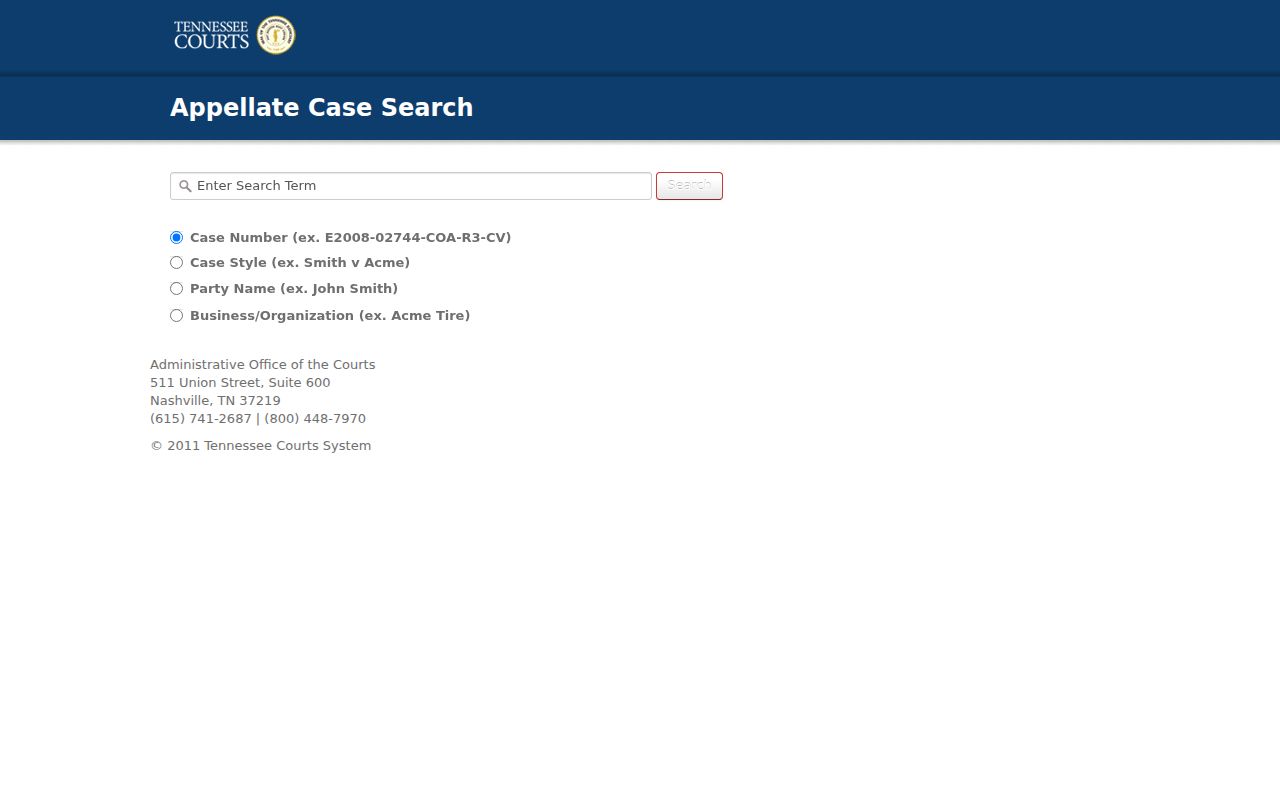
That official search page covers appellate cases only. It does not index Moore Circuit, Chancery, General Sessions, or probate actions. When an appeal shows up but you need the complaint, the trial order, or the complete Moore County civil docket, take the trial number to the right local clerk. This is the key step.
A failed search means little. The case may never have been appealed. Migration coverage and search terms can also hide a valid hit. So an empty result is not proof that no Moore civil case exists.
What Cases Fill the Civil Docket
Civil work in Moore County splits by subject and court authority. Circuit takes general civil claims. Chancery takes equity and family matters. General Sessions handles limited civil work. Access rules shift with the case type and the document, and domestic, probate, juvenile, medical, financial, and identifying details may face special limits.
- Contract, debt, and specific-performance actions in Circuit.
- Tort and property claims within Circuit jurisdiction.
- Appeals to Circuit from General Sessions or an administrative hearing.
- Equity, real-property, and other Chancery matters.
- Domestic-relations, estate, probate, and trust matters assigned to Chancery.
Moore County publishes no case-type code list. A short label alone proves little. Don't stretch it into a claim the docket cannot support. Ask the clerk what a local category means, then request the initiating pleading or final order for the exact nature and result of the action.
Moore Civil Filing Snapshot
The AOC 2025 Circuit filings report covers July 1, 2024 through June 30, 2025. Moore Circuit shows seven civil filings in its type table. Those break down as one appeal from an administrative hearing, three contract/debt/specific-performance cases, one divorce without minor children, and two miscellaneous general civil matters. The categories stay broad.
Count filings, not outcomes. Those seven are a period count, not the number of pending Moore County civil cases, and not a forecast. Circuit categories only. Chancery and Sessions work is left out, so use the numbers for context, never to locate a case or read one docket's status.
Hearings on the Civil Docket
Moore County Chancery hearings follow a schedule set by the 17th District local rules. Regular Chancery sessions land on the third Monday of March and September. Docket call opens each session. Those dates are not set in stone, though. Holidays, conferences, and other events can push them around. Always check before you rely on one.
Who schedules your matter depends on what kind it is. Contested cases go through the Chancellor's calendar. You coordinate the date with the Chancellor or the secretary. Uncontested matters are simpler. The Clerk & Master schedules those directly. Either way, confirm the date, time, courtroom, judge, and setting type with the clerk. After a continuance, the newest docket entry beats an older notice every time. Want to tell a docket call apart from a hearing or trial? The Moore County court schedule breaks it down.
The official Rule 18 local-rule authority is where this schedule comes from. It shows how adopted local practice rules govern civil scheduling in the district.
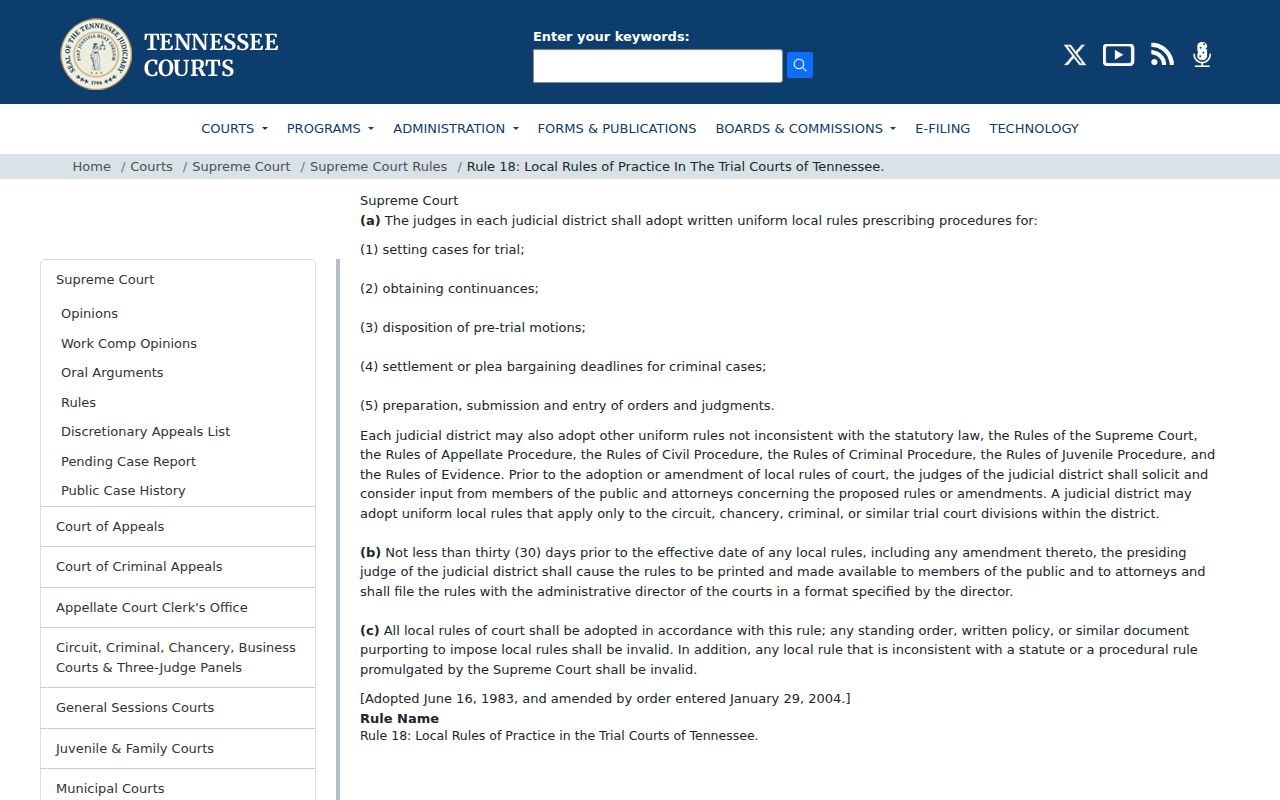
A district rule sets the regular Chancery framework. Still, a current confirmation from the Moore County clerk is what makes a civil docket date trustworthy.
Moore Civil E-Filing Is Not Search
Electronic filing in Tennessee works by permission, not by default. Tennessee Rule of Civil Procedure 5B lets Circuit, Chancery, and other listed trial courts adopt e-filing through local rule. Registered users can then file and receive service that way. Where does Moore County stand? The AOC annual report lists Moore Chancery and Moore Circuit under "have Applied." That label speaks only to filing. It promises no public case search and no free document viewer for either court.
The official TnCourts trial e-filing landing page is a filing route only. It depends on local adoption. A member of the public hunting an existing Moore County docket still has two stops. Those are the Circuit Clerk and the Clerk & Master. The courts offer no public query form, no public login tier, and no posted document fee for civil docket searching.
Key distinction: “Have Applied” describes an e-filing status in an annual report. It does not mean “implemented,” “publicly searchable,” or “all documents online.”
Rule 46B allows local email-filing rules too. Moore County has adopted none. So do not email sensitive case data or attachments unless the clerk gives current written instructions.
Who Can See Civil Dockets
Court records in Tennessee start from a presumption of openness. Tennessee Supreme Court Rule 34 sets that presumption. It also keeps real exclusions and limits in place. Sealing is one limit. Under the Rule 1A civil sealing framework, a party must make a specific showing. The court must weigh less restrictive means too. In practice, a public Moore County docket may list a case number and "order filed" while the document itself stays redacted or withheld. A sealed action may vanish from view or show only limited entries.
Request rule: No online result is not the same as a sealed record. Ask the clerk whether no portal exists, an image is restricted, the case is sealed, or a court order is needed.
The Tennessee Public Records Act shapes how you ask, but it cannot override court rules, statutes, or protective orders. The Comptroller's TPRA FAQ covers inspection, copies, timing, fees, citizenship, and written denials. Make your request precise. Name the Moore court, the case number or caption, the approximate year, the date range, and the exact docket or document you need.
Historic Moore Civil Dockets
Where a Moore County court docket lives depends on how old it is. Active files stay with the court clerk at 196 Main Street. For historic material, Moore County Archives sits at 241 Main Street, Suite 105. Its State Library and Archives directory lists Chancery and Circuit series going back to 1872. That includes Chancery dockets through 1958 and Circuit dockets through 1944. Those dates describe what the directory lists, nothing more. They do not promise every file survives. Nor do they rule out some earlier record.
Call Archives first at 931-759-7068 before you drive over. Give staff the court series, the year, and the party or estate name. Ask whether the original file is still at the courthouse. The directory says anything Archives does not hold remains there. Hours are limited. A copier is available on site. The facility listing notes there is no internet or wireless access.
One more thing about old records. Probate, wills, trusts, deeds, and older Chancery material may be indexed differently than an active Circuit case. Ask narrow questions. That saves time and keeps you from requesting the wrong records from the wrong office.